On the last digits of conscutive prime numbers
If you have a prime number $p$ (other than two and five) then the last digit of $p$ is 1, 3, 7, or 9. If for some reason we believe that prime numbers are randomly distributed (after all, the last digits 1,3,7, and 9 appear equally likely among primes), then we expect if a prime numbers ends in 1, then the next prime number also ends in 1 with probability of 1/4. A recent study has shown otherwise, statistically, and has proved it mathematically, assuming the Hardy–Littlewood k-tuple conjecture is true. In fact the statistical data shows the probability is less than 1/4. Here is an article explaining the main content of this study.
And if you want to check it for yourself, here is a little code that finds the empirical probability of two consecutive prime numbers ending in the same last digit:
n = 100000
Primes = primes_first_n(n)
q = 10
Qrimes = []
for p in Primes:
    Qrimes += [p % q]
count = [ 0 for i in range(q) ]
for i in range(n-1):
    a = Qrimes[i]
    if a == Qrimes[i+1]:
        count[a] += 1
        #print(Primes[i],Primes[i+1])
(sum(count)/(n)).n(32)
0.153300000
And here is a modification that shows how the probability changes as $n$ grows:
n = 1000000

Primes = primes_first_n(n)
q = 10

Qrimes = []
for p in Primes:
    Qrimes += [p % q]

Probs = []

count = [ 0 for i in range(q) ]
for i in range(n-1):
    a = Qrimes[i]
    if a == Qrimes[i+1]:
        count[a] += 1
        Probs += [[i,(sum(count)/(i))]]

P = point(Probs)
P
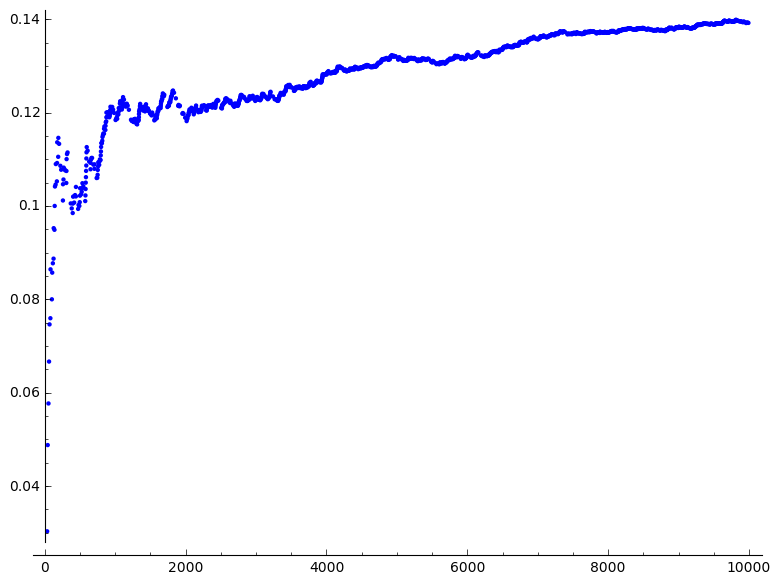 As $n$ grows (horizontal axis) the empirical probability of having two consecutive prime numbers with the same last digit (vertical axis) changes but remains well below 1/4.
The fun part is by noting the last digit of a number is just the remainder mod 10, then you can ask about what happens to the remainders mod some other number $q$. In the paper they show the probability is still less than what one would expect mod any number $q$, which sounds paradoxical.
Leave a comment