Discovering Perspectives Through Colorblindness
One of the most enlightening conversations I’ve had recently started with my friend sharing how his colorblindness influenced his life choices—even leading him away from a potential career as a painter. To help us understand his perspective, he introduced our group to a common colorblindness detection tool: the Isishara test. This test consists of a circle filled with smaller colored dots, arranged so that people with normal color vision can see a number within the pattern. For someone with colorblindness, however, the number might be invisible or hard to discern.
Here’s an example of what the Ishihara test looks like:
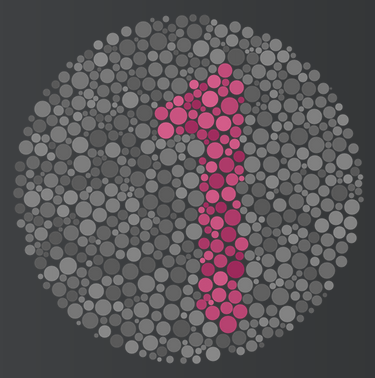
Many people have some degree of colorblindness without realizing it. Often, it’s mild or affects colors they don’t use frequently. The fascinating part of this experience, however, isn’t just the test itself. It’s the realization of how differently we all perceive the world.
When we did the test as a group, some of us saw the number in the circle immediately, while others had to strain to make it out. A few friends couldn’t see it at all, even after we pointed it out. The real eye-opener came when I experienced what it feels like to be on the other side: to not see something others insist is “so obvious”.
This shared experience reminded me of those moments when I struggle to understand why someone “just doesn’t get it”. Sometimes, concepts or ideas that feel crystal clear to me can be utterly incomprehensible to someone else, and vice versa. Just like with colorblindness, we all have “blind spots” in other areas of life. Recognizing this can foster greater empathy and patience.
Seeing Colors Differently
A similar revelation occurred during a recent conversation in our group chat. A friend shared a photo of her flowering plant, proudly announcing that the blooms were pink. Yet two of us insisted they were red! This again got me thinking about how differently people perceive colors. Is it a matter of personal definitions? Or do we genuinely see different shades?
Curious, I decided to experiment. I created a webpage (with some help from an LLM, I’m no coding expert!) that lets people define where red ends and pink begins on a spectrum. Here’s a preview of what I saw:

Try it yourself here and see where your perception stands. It’s a simple yet fascinating way to explore how subjective color perception can be.
Embracing The Differences
Whether through colorblindness tests or conversations about flowers, these experiences have taught me that differences in perception aren’t just fascinating, they’re essential reminders of how unique each person’s experience is. What seems obvious to one might be invisible to another, and that’s okay. It’s an opportunity to understand, connect, and see the world through someone else’s eyes.
So next time you’re in a group, why not try the Ishihara test? Not only is it a fun activity, but it also opens the door to deeper conversations about how we perceive and interpret the world around us.
Leave a comment